

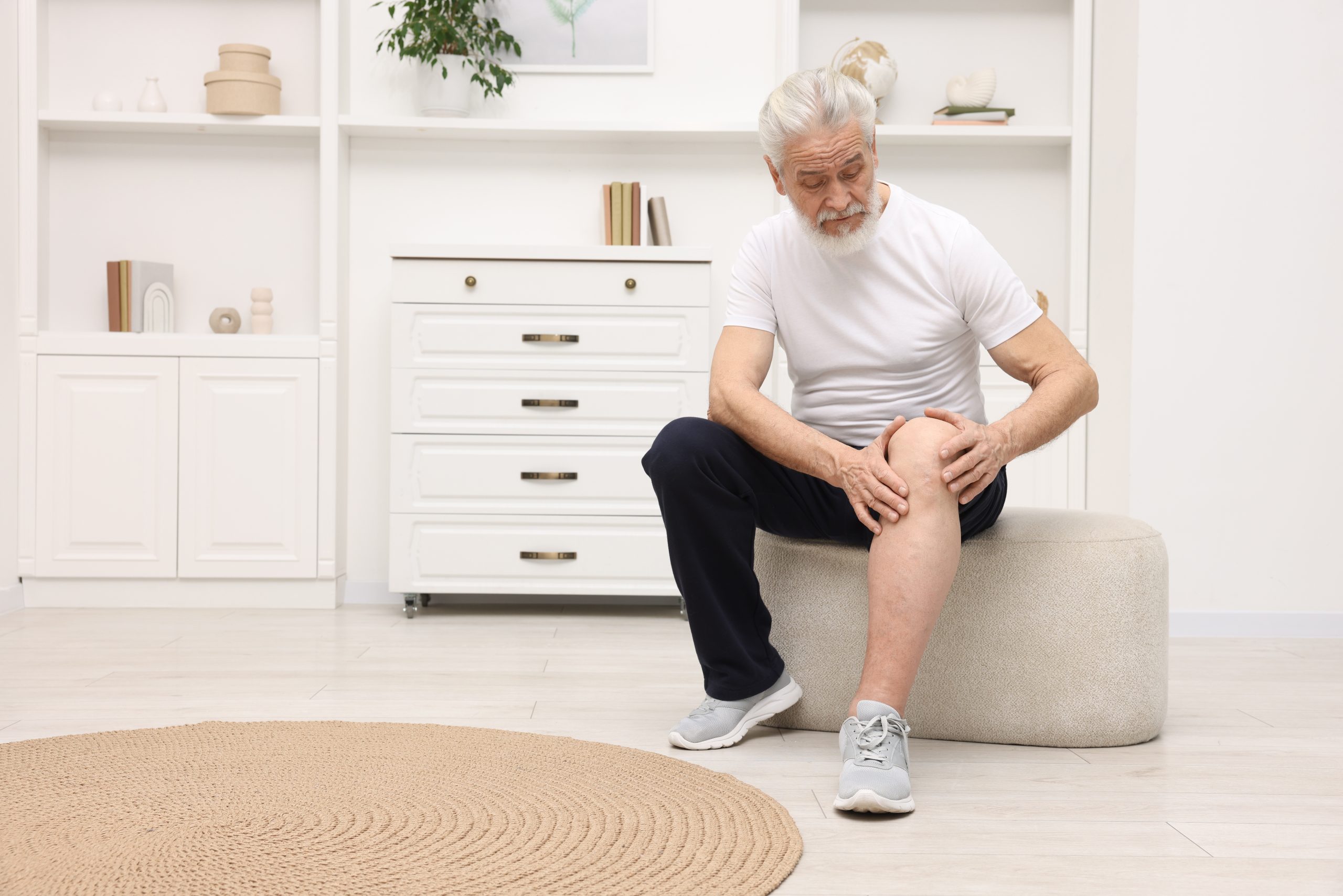
Knee pain treatment starts with understanding its most common culprit in older adults: osteoarthritis (OA). The Centers for Disease Control and Prevention (CDC) estimates that more than 32 million Americans live with this condition, making it the leading cause of disability in people over sixty.
Unlike the sharp pain that typically follows an injury, osteoarthritis develops gradually, and almost imperceptibly, over many years. The phrase “wear and tear” arthritis gets tossed around often, but it undersells the biological complexity at work.
Articular cartilage is the main problem. It’s a thin but resilient tissue lining the knee joint, and it absorbs shock and keeps bones from grinding during movement. In younger joints, this tissue does its job well.
But over time, cartilage loses moisture and becomes increasingly brittle. As that cushioning layer thins, the bones gradually converge.
In advanced cases, they make direct contact, triggering inflammation and prompting your body to form bony growths called osteophytes. The result is a cycle of deepening pain and diminishing mobility.
Some individuals notice mild morning stiffness and attribute it to aging. Eventually, ordinary tasks become painful. Their experience illustrates something important about OA: it rarely announces itself. The progression is slow, and the body’s attempts to compensate, like forming extra bone, worsen your stiffness and discomfort.
Imaging doesn’t always mirror a patient’s lived experience. Some older adults show significant cartilage loss on X-rays yet report little pain — a reminder that OA is far more nuanced than any single scan can reveal.
“X-rays are an appropriate screening test for knee pain in older patients,” states Harvard Medical School. “Often the results of an x-ray can tell whether an MRI would be even helpful. In addition, an MRI costs about 12 times that of an x-ray (based on Medicare rates) and can take an hour to perform.”
Some patients struggle daily despite only mild imaging findings. That disconnect is telling. Pain in the knee isn’t just a story of cartilage loss, as your muscles, nerves, and circulatory structures surrounding the joint can shape your comfort.
Emerging research in neuro-orthopedics makes it clear that the nervous system has a remarkable capacity to amplify or dampen pain signals, independent of how much cartilage remains. How the brain interprets and processes those signals matters enormously.
Cartilage, Joint Health, and Knee Pain Treatment
In the early stages, cartilage deterioration is silent. Because cartilage contains no nerve endings, the joint can be quietly degrading long before pain enters the picture. Morning stiffness eventually loosens after a few minutes, or a faint clicking and grinding happens when rising from a chair.
Cartilage is also unusual in that it has no direct blood supply. Instead, it relies on a process called imbibition to stay nourished. Think of cartilage as a dense sponge submerged in nutrient-rich fluid. Each time you walk and bear weight, the cartilage compresses, and when the pressure releases, it draws fresh fluid back in, delivering nutrients and clearing out waste.
Regular movement, in other words, feeds the tissue. When pain leads someone to stop moving, that supply chain breaks down, and the damage can accelerate.
Maintaining cartilage health also depends on specialized cells called chondrocytes, which function as the tissue’s internal repair crew. In younger joints, they manage that balance reasonably well. With age, their efficiency declines, as repair slows and breakdown speeds up.
The synovial membrane lining the joint can become inflamed, a condition called synovitis. This releases compounds that degrade cartilage even faster. It’s a self-reinforcing cycle.
Clinicians are increasingly focused on interrupting that cycle before it gains momentum. Controlling inflammation improves mobility, and improved mobility supports cartilage health.
Viewing OA as a biological process rather than a purely mechanical one has meaningfully shifted how joint care is approached — a shift reflected in the most effective treatment strategies available now.
Surgical Questions and Corticosteroids Explained
Severe knee pain doesn’t mean knee pain treatment surgery is inevitable, though that assumption is common.
Joint replacement has genuinely transformed lives, but it remains a significant procedure, carrying real risks like extended recovery, potential infection, and blood clots. Most older adults prefer to protect their natural joints for as long as reasonably possible. Physicians today largely share that instinct, favoring a layered, stepwise approach that exhausts less invasive options before any surgical conversation begins.
Choosing non-surgical care isn’t about postponing the inevitable. It’s about matching treatment to where a person actually is. Research suggests that up to 30 percent of knee replacement patients still experience pain or unmet expectations after surgery — a sobering figure.
Preserving your original joint also means preserving proprioception, the body’s innate sense of position and movement. This supports balance and natural gait in ways an artificial joint simply cannot fully replicate.
“Knee treatment without surgery (or before and after surgical intervention) involves physical and rehabilitative medicine and exercise programs to stretch and strengthen knee muscles, improving flexibility and support,” according to Penn Medicine. “Changing how you do daily activities can help reduce knee pain by avoiding extra strain. Special therapeutics and gear designed for knee pain can also help.”
When lifestyle modifications and basic pain relievers fall short, joint injections are typically the next step. Corticosteroid injections are the most widely used option. When delivered directly into the knee, they can meaningfully reduce inflammation within a couple of days, usually restoring enough comfort to get someone moving again during a difficult flare.
That said, corticosteroids have a defined role and clear limits. They manage swelling effectively but do nothing to rebuild damaged tissue. Think of them less as a treatment and more as a reset. It’s a way to reduce pain enough that someone can re-engage with physical activity and rehabilitation.
Because repeated steroid injections can actually harm cartilage over time, most physicians aim to stay well under four per year. Precision matters here, too. Ultrasound-guided delivery has become increasingly standard, improving accuracy, enhancing effectiveness, and reducing your discomfort.
Hyaluronic Acid for Joints, and Which Injection to Choose
Hyaluronic acid injections are an interesting knee pain treatment alternative for those who aren’t good candidates for steroids or simply want a different approach.
The technique, commonly called viscosupplementation, involves injecting a gel-like substance directly into the knee joint. In a healthy knee, synovial fluid is naturally thick and lubricating, largely because of hyaluronic acid.
The goal of viscosupplementation is to restore some of that natural viscosity. Unlike corticosteroids, though, the relief isn’t immediate. Most patients wait several weeks before noticing a huge difference. When it does work well, the benefits tend to last around six months, which makes it a particularly appealing option for people managing mild to moderate OA who want long-lasting relief.
Choosing between these two injection types really comes down to individual circumstances. Corticosteroids are the better fit when someone needs fast relief — before a trip, a family event, or a stretch of demanding activity. Hyaluronic acid makes more sense when the priority is sustained comfort over a longer window.
Some pain management specialists combine both strategically, using a steroid injection first to quiet acute inflammation, then following with hyaluronic acid to maintain the joint environment.
Beyond these established options, platelet-rich plasma (PRP) and stem cell therapies are drawing growing interest in orthopedic circles. Both approaches leverage the body’s own regenerative biology, attempting to repair damaged tissue rather than simply manage symptoms. Research is still catching up to the enthusiasm, and specialists are carefully evaluating whether these treatments can produce genuine structural benefit, not just pain relief.
Having a conversation with a knowledgeable pain management doctor is the best way to determine which combination of therapies fits your lifestyle, your goals, and the specific condition of your joint.
Manual Therapy, Medical Massage, and Knee Pain Treatment
While injections address what’s happening inside the joint, manual therapies take a broader view. They entail examining how the entire leg functions as a coordinated system.
Chiropractic care for older adults rarely involves forceful adjustments. Instead, practitioners typically use gentle mobilization techniques targeting the hips, pelvis, and ankles. When the hip stiffens or the pelvis tilts out of alignment, the knee quietly absorbs the excess strain, and that added load tends to accelerate cartilage wear over time.
This is where the kinetic chain model becomes genuinely useful. The body’s joints are interconnected, and a problem in one area reliably influences others. A collapsed foot arch can cause the knee to rotate inward, concentrating pressure unevenly across the joint surface.
A chiropractor working with this framework isn’t just treating the knee — they’re working to distribute mechanical stress more evenly across the entire leg. Ignoring the hip or ankle while focusing exclusively on the knee is a bit like replacing one tire without checking the alignment of the others.
Often thought of as purely restorative, massage therapy is a legitimate clinical tool when chronic knee pain is involved. Pain naturally triggers the surrounding muscles — quadriceps, hamstrings, calves — to tighten protectively. That guarding response can end up compressing the joint further and amplify the very discomfort it’s trying to limit.
Targeted soft tissue work helps break that cycle. By releasing chronically tense muscles and improving local circulation, massage supports the delivery of nutrients to damaged tissue while helping clear inflammatory byproducts. It can also address restrictions in the fascia, the connective tissue wrapping around muscle fibers, that contribute to stiffness and reduced range of motion.
For older adults suffering from tightness every day, regular massage can meaningfully shift a guarded, rigid gait toward something noticeably freer.
There’s also a neurological dimension worth noting. Stimulating sensory nerves in the skin and muscle can interfere with pain signals before they reach the brain, providing a natural and often underappreciated form of relief.
Exercises That Support the Knee, and the Impact of Weight
Building strength in the muscles surrounding your knee delivers benefits that no injection or manual knee pain treatment therapy can fully replicate on its own.
Those muscles function much like a suspension system, absorbing load, stabilizing the joint, and reducing the mechanical stress that accelerates cartilage breakdown. Strong quadriceps offload pressure from your knee, and research consistently links targeted quadriceps strengthening to measurable reductions in OA-related pain.
For older adults, the key is finding exercise that builds that strength without punishing the joint in the process. Swimming or aquatic aerobics is well-suited here. Buoyancy eliminates up to 90 percent of the compressive force on the knee while the water’s natural resistance still challenges the muscles.
Stationary cycling is another excellent option, generating the fluid motion that keeps joints lubricated without the impact of weight-bearing exercise.
“A strength training routine can be done just using body weight and no special equipment,” states UCLA Health. “If you’re new to exercise, you might start with just a few repetitions of each move. People who are stronger may do several sets of each move or add weight. Progress slowly and listen to your body.”
The article says that muscle strengthening exercises include bridges, calf raises, lateral lunges, lunges, and squats – and for aerobic exercise, it’s great to focus on activities that get your knees moving without stressing them too much. These involve “low-impact activities… biking (indoors or out), rowing machine, swimming, walking, and water aerobics.”
Simpler home exercises matter too. Straight leg raises and wall sits can quietly build the stability the knee depends on. Physical therapists point to your small vastus medialis oblique muscle along the inner thigh because of its direct role in keeping the kneecap properly tracked. The goal here isn’t building bulk. It’s developing a supportive muscular envelope that relieves pressure on the cartilage beneath.
Body weight is another variable. For every pound lost, the compressive force on the knee decreases by roughly four pounds with each step, a multiplier that becomes even more pronounced on stairs or inclines. Even modest weight loss tends to produce noticeable improvements in daily comfort.
Sustainable weight management works best when it’s built around consistent nutritional habits rather than restrictive dieting. Research shows that adipose tissue actively releases inflammatory compounds that can accelerate joint damage. Incorporating anti-inflammatory foods like omega-3-rich fish, leafy greens, berries, and walnuts addresses both, easing pain while supporting a healthier weight over time.
Overcoming Your Fear of Walking
Many older adults stop attending social outings or visiting friends simply because a short walk has become too uncomfortable to risk. Regaining the confidence to move freely again is as much a psychological process as a physical one.
A technique called graded exposure is particularly effective here. The idea is straightforward: start with a very short, manageable walk, perhaps just to the end of the driveway, and add distance incrementally as each step feels less threatening.
Medical treatments like injections or physical therapy support these small advances, but the mental dimension matters just as much. Each completed walk, however brief, reinforces the next one. Reaching a park bench or finishing a slow lap around the block is a major milestone.
Returning to comfortable, regular movement requires a thoughtful, layered plan rather than a single fix. A precise diagnosis is the right starting point — imaging such as MRI or ultrasound gives a clinician an accurate picture of what’s actually happening inside the joint. From there, short-term relief options like corticosteroid injections can be weighed against longer-lasting approaches like hyaluronic acid, depending on individual needs and goals.
Structural support through chiropractic care or massage helps address alignment and circulation, while low-impact strengthening exercises build the muscular stability the knee depends on. An anti-inflammatory diet lightens the biological load on the joint from the inside.
Perhaps most importantly, responding to pain early preserves options and protects your joints from avoidable further damage. A regular walk can realistically become part of daily life again with the right combination of care and effort.
Knee Pain Treatment: A Non-Surgical Reference Guide
No single knee pain treatment reliably resolves knee pain on its own. In fact, understanding how different options compare makes it considerably easier to build a plan that actually holds up over time.
The most successful patients tend to combine approaches thoughtfully, layering treatments that address different aspects of the problem simultaneously.
The table below outlines the key features of the primary non-surgical options, offering a practical reference for your next conversation with a pain management specialist:
| Treatment Type | Primary Benefit | How It Works | Typical Frequency |
| Corticosteroids | Rapid pain relief | Potent anti-inflammatory agent that shuts down acute flares. | 3-4 times per year max |
| Hyaluronic Acid | Long-term lubrication | Restores thickness of joint fluid to cushion and protect cartilage. | Every 6 months |
| Chiropractic Care | Improved alignment | Ensures hips, ankles, and spine are balanced to reduce knee stress. | Weekly to monthly |
| Medical Massage | Muscle relaxation | Releases guarding tension and improves local blood circulation. | Bi-weekly to monthly |
| Strength Training | Joint stabilization | Builds a muscular sleeve (quads/glutes) to take load off bone. | 3-4 times per week |
| Weight Management | Pressure reduction | Lowers mechanical force; 1 pound lost = 4 pounds pressure removed. | Daily lifestyle focus |
| Regenerative Biologics | Tissue health | Uses body’s own cells (PRP/Stem Cells) to improve joint environment. | Once or as needed |
An injection might deliver short-term relief, but physical conditioning and weight management are what sustain it.
Common Questions About Senior Knee Health
Managing knee pain raises practical questions, especially for older adults who want to move freely without pursuing knee pain treatment surgery.
Below are some of the most common questions that come up when exploring non-surgical options:
- How do I know if I actually need a knee replacement or if injections will work? Specialists rarely base the decision for surgery on an X-ray alone. It is a lifestyle decision. If you have tried conservative treatments for six months and you still cannot perform basic daily tasks, surgery may be the next step.
- Are the injections into the knee painful? While the thought of a needle in the joint is intimidating, most patients report that the sensation feels much less intense than expected. Additionally, using ultrasound guidance allows the doctor to enter the joint space smoothly and accurately.
- My knees make a grinding or popping noise when I walk. Does that mean I’m doing more damage? Not necessarily. Medical professionals call this noise crepitus, and it is very common in seniors with osteoarthritis. If the noise does not accompany pain, it is generally just the sound of uneven cartilage or ligaments moving over bone. However, if the grinding feels painful, it suggests the cartilage is thin.
- Can I still go for my morning walk if my knees are stiff? Yes, and in most cases, you should. A gentle walk helps circulate that fluid and warm up the joint.
A Thoughtful and Balanced Approach
A few good habits can support whatever knee pain treatment plan you’re following.
Temperature therapy is a good example. Starting the morning with gentle heat — a warm towel or heating pad — helps loosen stiff muscles and makes early movement less uncomfortable. Ice, on the other hand, is better reserved for later in the day when acute inflammation flares after activity or overexertion. Used consistently, this simple rhythm can improve how the joint feels from morning through evening.
Footwear deserves more attention than it typically gets. Shoes with solid arch support or neutral cushioning help stabilize the foot and reduce the mechanical strain that travels upward into the knee. High heels and completely flat soles both compromise that stability in different ways, and either can quietly accelerate joint stress over time.
Cost is a practical reality worth addressing directly. Most standard treatments like physical therapy and injections are covered under typical insurance plans and Medicare. Regenerative options like platelet-rich plasma, however, usually fall outside that coverage and involve meaningful out-of-pocket expense. Before committing to any new therapy, a direct conversation with both your physician and your insurance provider will save you from unpleasant financial surprises.
Managing knee pain over the long term requires patience. Building muscle strength is a months-long process. That timeline can feel discouraging, but the progress is well worth the effort.
Wellness and Pain
Find your personalized knee pain treatment by visiting Wellness and Pain. We offer conservative treatments, routine visits, and minimally invasive quick-recovery procedures. We can keep you free of problems by providing lifestyle education and home care advice.
This enables you to avoid and manage issues, quickly relieving your inhibiting lifestyle conditions when complications arise. We personalize patient care plans based on each patient’s condition and unique circumstances. Wellness and Pain can help improve wellness, increase mobility, relieve pain, and enhance your mental space and overall health.